


Why Knowing Your Skin Type Changes Everything
Have you ever stood in a pharmacy aisle, a product in each hand, completely unsure which one is actually right for you? Or maybe you followed a skincare routine you read about online — only to wake up the next morning with your skin feeling tighter than ever, or somehow oilier than before.
You’re not alone. So many women go through this exact experience. And more often than not, the problem isn’t the product itself — it’s that it simply wasn’t made for your skin.
Learning how to determine your skin type is the single most important step you can take before investing in any serum, moisturizer, or cleanser. It’s the difference between a routine that genuinely supports your skin and one that quietly makes things worse.
What if your skin could feel balanced, calm, and truly cared for — every single day? That starts here.
The 5 Main Skin Types — Which One Are You?
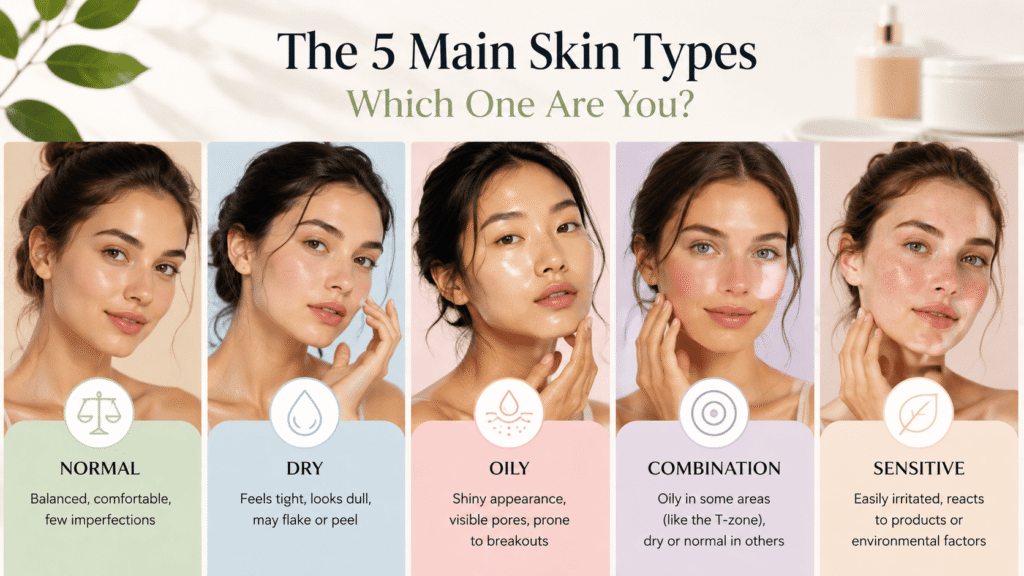 Before you can figure out how to determine your skin type, it helps to know what you’re actually looking for. Dermatologists generally recognize five main categories. Each one has its own personality — and its own needs.
1. Normal Skin
Think of it as the skin that just… cooperates. It’s not too oily, not too dry. Pores are barely visible. It rarely breaks out without reason, and it tends to bounce back quickly after stress or seasonal changes. If this sounds like you, you’re lucky — and a simple, consistent routine will help you keep it that way.
2. Dry Skin
Dry skin often feels tight — especially after cleansing or stepping out of the shower. You might notice flakiness around the nose, forehead, or cheeks. Fine lines may appear more pronounced. Many women with dry skin describe that uncomfortable “pulling” sensation throughout the day. Rich, hydrating products tend to feel like a warm hug for this skin type.
3. Oily Skin
By noon, your foundation has migrated. Your T-zone is shining. Sound familiar? Oily skin produces more sebum than needed, which can lead to enlarged pores, shine, and more frequent breakouts. The good news? Oily skin tends to age more slowly, since natural oils help keep it supple.
4. Combination Skin
This is one of the most common skin types — and one of the most misunderstood. Your T-zone (forehead, nose, chin) tends to be oily, while your cheeks can feel dry or normal. Products that work for one zone may irritate the other. It takes a little more strategy, but combination skin absolutely can be balanced.
5. Sensitive Skin
Sensitive skin reacts. To fragrances, to harsh ingredients, to stress, to weather changes — sometimes all in the same week. Redness, stinging, itching, or visible irritation after trying new products are common signs. If your skin has strong opinions about what it does and doesn’t tolerate, gentle and minimal is the way to go.
💡 Note: Sensitive skin is a condition that can occur alongside any skin type — it’s not a standalone type. You can have oily-sensitive or dry-sensitive skin at the same time.
How to Determine Your Skin Type at Home (The Bare-Face Test)
 You don’t need to visit a dermatologist or buy a fancy device. One of the most reliable methods to determine your skin type is something you can do right at home, in about an hour. Here’s how:
The Bare-Face Method — Step by Step
- Cleanse your face with a gentle, fragrance-free cleanser and pat it dry.
- Don’t apply any products afterward — no toner, no moisturizer, no serum. Leave your skin completely bare.
- Wait 30 to 60 minutes. Go about your morning — make coffee, get dressed, check your phone.
- Look at your skin in natural light. Really look at it.
What You’re Seeing
- Shiny all over? → Oily skin
- Tight, flaky, or dull? → Dry skin
- Shiny T-zone, normal or dry cheeks? → Combination skin
- Comfortable, balanced, no major issues? → Normal skin
- Red, irritated, or reactive even without products? → Sensitive skin is a factor
The Blotting Paper Method (Bonus Test)
Gently press a blotting paper on different areas of your face after an hour of wear. Hold it up to the light. If there’s oil on the paper from all zones — oily. If only from the T-zone — combination. Little to no oil — dry or normal.
What Your Skin Is Really Trying to Tell You
Have you ever thought your skin was just being difficult — reacting to everything, never settling down? Here’s a perspective shift that might help: your skin is always communicating. It’s not working against you. It’s asking for something.
Breakouts along the jawline can signal hormonal changes. Persistent dryness despite moisturizing might mean your skin barrier needs extra support. Sudden oiliness after using a new cleanser? Your skin may be overcompensating because it’s been stripped of its natural oils.
Many women notice that their skin type can shift with seasons, hormones, stress levels, or even diet. What worked beautifully in your 20s may need adjusting in your 30s or 40s. Re-testing your skin type every year — or whenever something feels off — can be a genuinely useful habit.
Now that you know how to determine your skin type, the next logical step is understanding how to build a routine that actually works for you.
If you’re unsure about the correct order of products or which steps truly matter, you may find this guide helpful:
⇒ 7 Essential Skincare Routine Steps for Radiant Skin
It walks you through exactly how to layer your products the right way.
Building Your Routine Around Your Skin Type
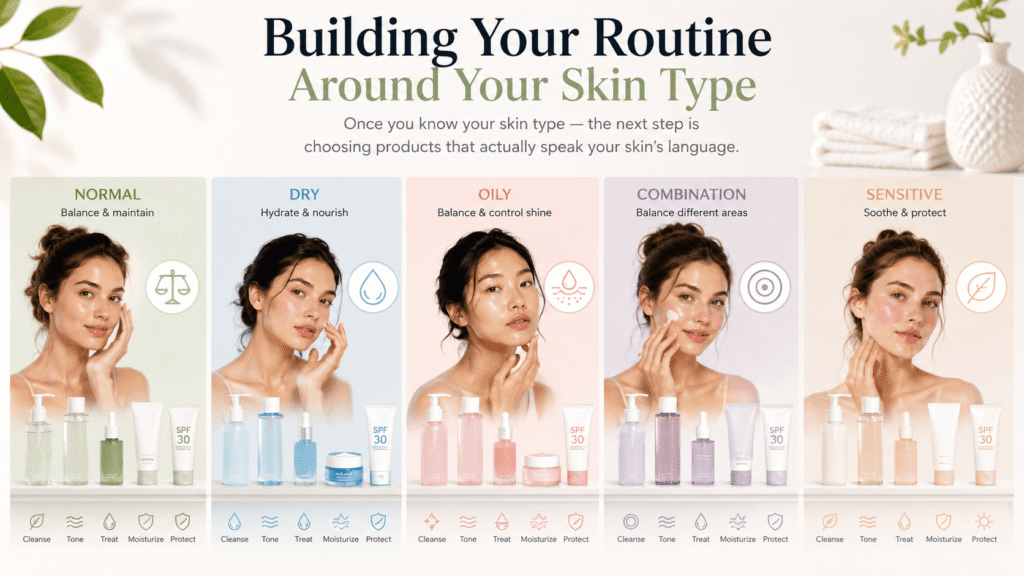 Once you know how to determine your skin type — and you’ve identified yours — the next step is choosing products that actually speak your skin’s language.
For Dry Skin
Look for rich, creamy moisturizers with ingredients like hyaluronic acid, ceramides, and squalane. Gentle, non-foaming cleansers may support your skin barrier without disrupting its natural oils. Avoid heavy alcohol-based toners that can leave skin feeling stripped.
For Oily Skin
Lightweight, water-based moisturizers and gel cleansers tend to work well. Niacinamide is a popular ingredient that many women with oily skin find helpful for managing shine. Don’t skip moisturizer — even oily skin needs hydration. Skipping it can sometimes make oiliness worse.
For Combination Skin
The multi-masking approach can be a game-changer here — using different products on different zones. A balancing toner across the whole face, paired with a lighter moisturizer on oilier areas and a richer one on dry patches, may help bring things into harmony.
For Sensitive Skin
Fragrance-free, minimal-ingredient formulas are your best friend. Introduce new products one at a time and patch-test before applying anything to your full face. Look for soothing ingredients like aloe vera, centella asiatica, or oat extract.
Quick Tips, Final Thoughts & What to Do Next
Understanding your skin doesn’t have to be complicated. It just asks for a little attention — and a little patience.
- Re-test your skin type each season — it can genuinely change.
- Give a new product at least 2–4 weeks before deciding whether it works.
- Introduce one new product at a time, so you always know what’s making the difference.
- When in doubt, simpler is usually safer — especially for sensitive or reactive skin.
- A dermatologist can offer a professional assessment if your skin is consistently reactive or hard to read.
Your skin is yours. It tells the story of your health, your environment, your choices — and yes, your stress levels the week before a big event. When you take the time to truly understand it, you give yourself the foundation to care for it in a way that actually works.
So take the test. Look at your skin with fresh eyes. And build a routine that feels less like a guessing game — and more like something made just for you.
For deeper scientific reading, the Journal of Clinical and Aesthetic Dermatology offers peer-reviewed research on skin classification: https://www.ncbi.nlm.nih.gov/pmc/articles/PMC4037445/