
When Your Skincare Is the Problem
Have you ever done everything right — cleansed gently, applied your moisturizer, added a serum you spent a long time researching — and still woken up to red, irritated, unhappy skin?
 It’s one of the most disheartening feelings. Especially when you’re trying so hard.
Here’s something that might actually bring you some relief: it’s not your fault. And it’s probably not your skin “being difficult.” More often than not, it’s an ingredient. A specific one, hiding in a product you trusted, quietly triggering a reaction every single time you use it.
Understanding the ingredients to avoid for sensitive skin is genuinely one of the most powerful things you can do for your routine. Not because you need to become a cosmetic chemist — but because once you know what to look for, you can finally stop guessing and start making choices that actually feel good on your skin.
What if your skin could feel calm every morning? Settled. Comfortable. Not reactive, not red, not tight or burning after your routine? That’s not an impossible dream. It starts with knowing what to leave out.
Understanding Ingredients to Avoid for Sensitive Skin
Sensitive skin isn’t a flaw. It’s simply skin that communicates more loudly than other types. It reacts to disruption quickly — whether that’s a change in weather, stress, or something in your moisturizer that your skin simply doesn’t tolerate.
The tricky part? Many of the most common irritants are found in beautiful, well-reviewed, expensive products. They’re not “bad” ingredients for everyone. But for sensitive skin, they can be a consistent source of redness, stinging, itching, or breakouts.
Before you start choosing products, it’s essential to know your skin type, as this determines what suits it and what should be avoided. If you’re unsure about your skin type, you can check out our complete guide: How to Determine Your Skin Type: The Complete Guide with an Easy At-Home Test.
The ingredients to avoid for sensitive skin aren’t always obvious. Some hide under unfamiliar names. Others sound harmless — even natural and wholesome. That’s why knowing the list matters.
Let’s go through them one by one.
1. Fragrance — The Number One Offender
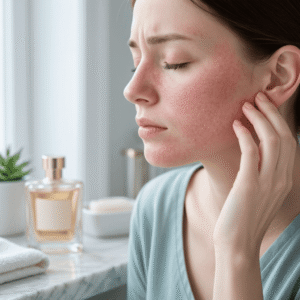 If there is one ingredient to avoid for sensitive skin above all others, it’s fragrance.
Fragrance is the leading cause of contact dermatitis in skincare products, according to dermatologists worldwide. It can appear on labels as “fragrance,” “parfum,” “scent,” or even hidden inside terms like “aroma.” And it doesn’t matter whether it’s synthetic or derived from flowers — for sensitive skin, fragrance is fragrance.
The frustrating thing is that fragrance makes products feel luxurious. That beautiful smell when you open a new moisturizer? That’s exactly what your skin doesn’t need.
Many women notice a significant improvement in their skin’s behavior once they switch to fragrance-free products across their entire routine. Not just their moisturizer — everything. Cleanser, toner, serum, SPF, even their body lotion if it touches the face area.
What to look for on labels:
- Fragrance / Parfum
- “Natural fragrance” (still a blend of irritating compounds)
- Linalool, limonene, citronellol (fragrance components often listed separately)
2. Alcohol — Not All, But Many
This one requires a little nuance, because not all alcohols behave the same way.
The ones to be cautious about are drying alcohols — specifically denatured alcohol (also called alcohol denat.), ethanol, isopropyl alcohol, and SD alcohol. These are often added to products to help them feel lighter or dry down faster. But on sensitive skin, they can disrupt the skin barrier, cause stinging, and leave skin feeling tight and stripped.
You’ll find them frequently in toners, mattifying products, and some serums.
Fatty alcohols — like cetyl alcohol, stearyl alcohol, and cetearyl alcohol — are completely different. They’re actually moisturizing and generally well-tolerated. Don’t be alarmed when you see these on a label.
The simple rule: if “alcohol” appears in the first half of an ingredient list on its own or as “alcohol denat.,” it’s worth pausing.
3. Essential Oils — Natural Doesn’t Always Mean Safe
This is one that surprises a lot of women.
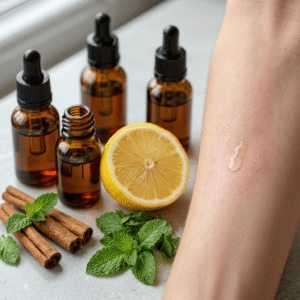
Essential oils have a wholesome, natural reputation. Lavender, tea tree, rose, eucalyptus, citrus oils — they smell incredible and they show up constantly in “clean beauty” products. But for sensitive skin, many essential oils are among the most significant ingredients to avoid.
They contain potent aromatic compounds that can trigger reactions, cause photosensitivity, and irritate the skin barrier — even in small amounts. Lavender oil, despite its calming reputation, is actually one of the more common culprits behind allergic reactions in skincare.
This doesn’t mean essential oils are universally harmful for everyone. But if your skin is reactive and you haven’t pinpointed why, checking your products for essential oils is absolutely worth doing.
Common essential oils that sensitive skin often dislikes:
 Lavender oil
- Eucalyptus oil
- Peppermint oil
- Citrus oils (lemon, orange, bergamot)
- Tea tree oil (in higher concentrations)
- Rosemary extract
 Lavender oil
4. Sulfates — Harsh Cleansers That Strip More Than Dirt
Sulfates are the foaming agents found in many cleansers, shampoos, and even some exfoliating washes. Sodium lauryl sulfate (SLS) and sodium laureth sulfate (SLES) are the most common.
They’re effective. That’s not the issue. The issue is that they can be too effective — stripping the skin of its natural oils and disrupting the moisture barrier that sensitive skin already struggles to maintain.
If you wash your face and it feels uncomfortably tight immediately afterward, there’s a reasonable chance your cleanser contains sulfates.
Switching to a sulfate-free, gentle cleanser is often one of the first changes that makes a visible difference for women with reactive skin.
5. Chemical Exfoliants Used Too Often or Too Strong
AHAs (like glycolic acid and lactic acid) and BHAs (like salicylic acid) have a well-deserved place in skincare. They can help with texture, tone, and clarity. But for sensitive skin, it’s not about whether to use them — it’s about how.
High concentrations, daily use, or layering multiple exfoliating products at once can lead to a damaged skin barrier, persistent redness, and that raw, over-sensitized feeling that takes weeks to calm down.
If you love chemical exfoliants and don’t want to give them up entirely, consider using them less frequently, at lower concentrations, and never alongside other active ingredients on the same night.
The goal is gentle progress — not a reaction.
6. Preservatives That Commonly Trigger Reactions
Preservatives are necessary — they keep products safe and prevent bacterial growth. But some are more likely to cause reactions in sensitive skin than others.
Worth knowing:
- Methylisothiazolinone (MI) and methylchloroisothiazolinone (MCI) — among the most common contact allergens in leave-on and rinse-off products; now restricted in many countries for leave-on products
- Formaldehyde-releasing preservatives — such as DMDM hydantoin, imidazolidinyl urea, and quaternium-15; these slowly release small amounts of formaldehyde, which can irritate sensitive skin
- Parabens — a more debated group; some sensitive skin types tolerate them, others don’t
This isn’t about fear — it’s about knowing your skin’s patterns. If you react consistently to certain products, checking for these preservatives may help you identify a pattern.
7. Artificial Dyes and Colorants
That pretty pink moisturizer or the soft lavender toner may look beautiful, but the dyes used to achieve that color serve no skincare purpose whatsoever. They’re purely aesthetic — and for sensitive skin, they can be an unnecessary source of irritation.
Look for terms like FD&C Red, D&C Yellow, or CI followed by a number. None of these need to be on your skin.
8. Menthol, Peppermint, and Cooling Agents
 That “cooling” sensation in some toners and cleansers feels refreshing. It feels like it’s working.
But that tingle? For sensitive skin, it’s often a sign of irritation rather than effectiveness. Menthol and peppermint can disrupt the skin barrier and cause reactive redness — especially around the nose, chin, and cheeks.
If a product makes your face feel tingly, that sensation isn’t a sign it’s doing something good. For sensitive skin, calm is always the goal.
9. Retinoids Without Proper Introduction
Retinoids — vitamin A derivatives — are some of the most well-researched ingredients in skincare. But they are also among the most likely to cause initial irritation, dryness, and peeling, particularly on sensitive skin.
This doesn’t mean sensitive skin can never use retinoids. Many women with reactive skin do use them successfully. But the introduction has to be slow — low concentration, infrequent use to start, always followed by a rich, gentle moisturizer.
Jumping in with a high-strength retinol every night is one of the more common ways sensitive skin ends up in a state of prolonged irritation.
How to Read an Ingredient Label Like a Pro
You don’t need a chemistry degree. Just a few simple habits:
- Ingredients are listed in descending order of concentration. What’s at the top matters most.
- If you see “fragrance” or “parfum” anywhere on the list — not just at the top — it’s present.
- The shorter the ingredient list, generally the fewer the opportunities for a reaction.
- When in doubt, patch test. Apply a small amount to the inside of your wrist or behind your ear for a few days before using a new product on your face.
The Environmental Working Group’s Skin Deep database allows you to search individual ingredients and products for sensitivity flags: https://www.ewg.org/skindeep/
The International Fragrance Association also publishes information on fragrance allergens: https://ifrafragrance.org/
Final Thoughts — Your Sensitive Skin Is Worth Protecting
Knowing the ingredients to avoid for sensitive skin isn’t about living in fear of every product on the shelf. It’s about becoming a smarter, more confident shopper — someone who reads labels with intention and chooses products that her skin can actually trust.
Have you ever found a product that just works? That your skin accepts quietly, without drama, without redness or reaction? That feeling of finally finding something your skin loves — it’s genuinely one of the small joys of a good skincare journey.
You deserve more of those moments. And fewer of the disappointing ones.
Start simple. Eliminate the biggest offenders first — fragrance, drying alcohols, essential oils. See how your skin responds over a few weeks. Build from there.
Once you know the ingredients to avoid, the next step is to choose the right moisturizer for your skin. For detailed recommendations for each skin type, check out our guide: Best Moisturizers for Each Skin Type: The Complete Guide to Finding Your Perfect Match.
Your skin isn’t the problem. Often, it’s just been given the wrong ingredients. And now that you know which ones those are, you’re already one step closer to a routine that actually feels like it was made for you.
♥ You might also enjoy:
⇒ How to Determine Your Skin Type: The Complete Guide
⇒ Best Moisturizers for Each Skin Type
⇒ How to Build a Minimalist Skincare Routine
Written with care for every woman whose skin just wants to feel calm — you’re not alone, and you’re in the right place.