

You’re standing in the beauty aisle, surrounded by hundreds of bottles, all promising you the skin of your dreams. And you freeze.
Sound familiar?
You’re not alone. Starting a skincare routine for beginners feels overwhelming — and honestly, it’s supposed to feel that way. Brands want you confused. Confused people buy more.
But here’s the truth your skin needs you to hear: a routine that actually works doesn’t start with ten products. It starts with understanding your skin, choosing the right ingredients, and showing up for yourself — consistently.
This guide is your honest, no-fluff map. No miracle promises. No complicated steps. Just real results, a little science, and a whole lot of self-care.
Why a Skincare Routine for Beginners Should Start With One Question
Before you buy anything — ask yourself: What does my skin actually need right now?
Not what your favorite influencer uses. Not the most expensive serum on the shelf. What your skin is asking for.
There are three main skin goals most of us fall into:
- Brightening — for dullness, dark spots, or uneven tone
- Repairing — for dryness, sensitivity, or a damaged skin barrier
- Tightening — for fine lines, loss of firmness, or early signs of aging
You don’t have to solve everything at once. Pick the goal that speaks loudest to you today, and build from there. The rest can wait.
The One Step You Can Never Skip: Daily Sun Protection
Before we talk serums and actives, we need to talk about the one habit that protects everything else you do for your skin.
Sunscreen. Every. Single. Morning.
UV rays are responsible for up to 80% of visible skin aging — dark spots, fine lines, loss of elasticity. Photoaging: The Role of UV Radiation in Skin Aging – All of it. And here’s the painful truth: if you’re using brightening or anti-aging products without sunscreen, the sun is quietly undoing your results every day.
What to look for: a broad-spectrum SPF 50+ with PA++++ rating. The SPF protects against UVB (burning), and the PA++++ protects against UVA (aging and pigmentation).  Apply it as your final morning step, after moisturizer, rain or shine. Sunscreen FAQs — American Academy of Dermatology
This isn’t just skincare advice — it’s self-respect in a bottle.

Step 1 — Brightening: Because Your Glow Was Never Gone, Just Hidden
What Brightening Really Means
Let’s clear something up: brightening is not about changing your natural skin tone. It’s about revealing the skin you already have — clear, even, and luminous — by reducing hyperpigmentation, sun spots, and post-acne marks.
Your skin produces melanin to protect itself. But sometimes — after a breakout, a day in the sun, or a hormonal change — certain areas overproduce it. That’s how dark spots form. Brightening ingredients step in and gently interrupt that process.
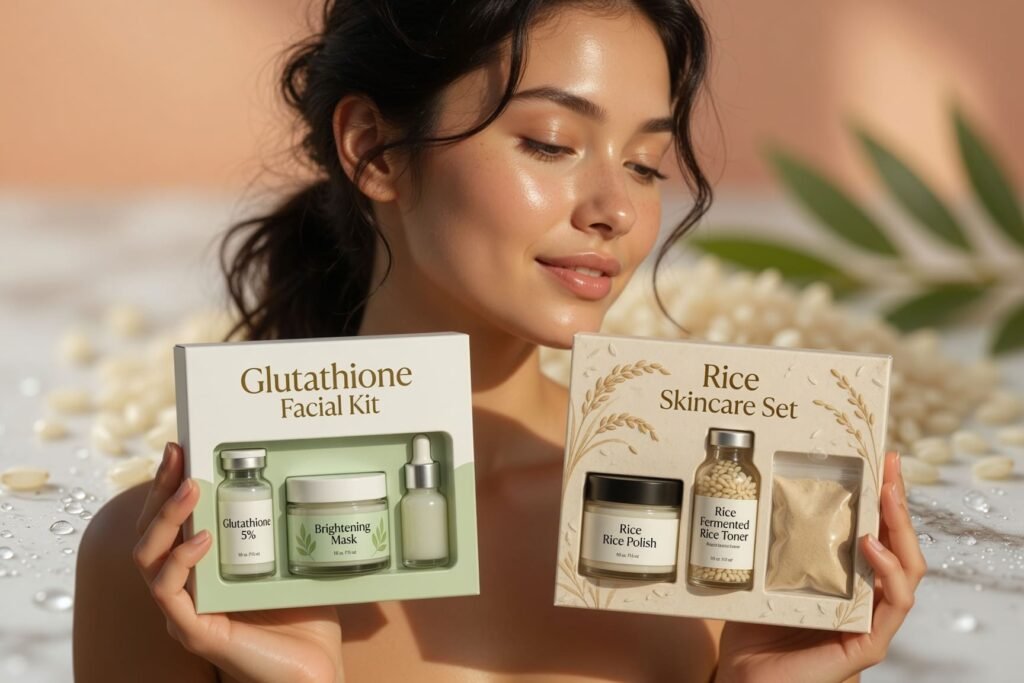
Rice Extract vs. Glutathione — Which One Is Yours?
Rice Extract
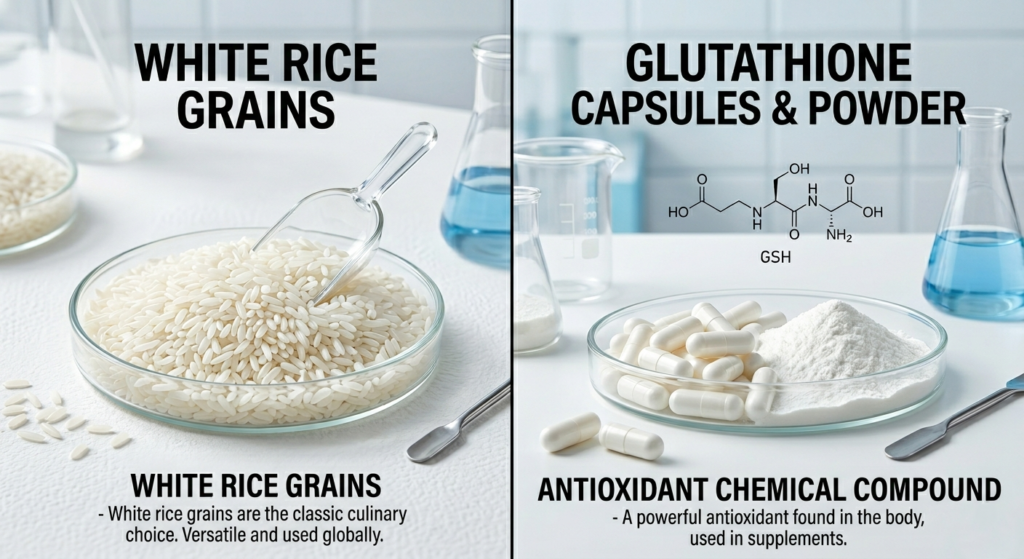
Thérèse a reason rice has been a beauty secret across Asia for centuries. Rice extract is rich in ferulic acid, niacinamide (vitamin B3), and natural antioxidants. It quietly — and kindly — fades surface dullness, evens out tone, and leaves skin with a soft, natural radiance.
It won’t rush. It won’t irritate. It’s the kind of ingredient you fall in love with slowly, noticing one morning that your skin just looks different — lighter somehow, more like yourself.
Best for: sensitive skin, mild dullness, first-time use of brightening actives.
Glutathione
If rice extract is a gentle hug, glutathione is a decisive hand on your shoulder.
Known as the “master antioxidant,” glutathione blocks the enzyme tyrosinase — the main driver of melanin production — making it one of the most targeted brightening ingredients available. It goes after stubborn dark spots that have settled in and refused to leave. Clinical Effects of Glutathione on Skin Color — PubMed Systematic Review
Best for: visible hyperpigmentation, post-acne marks, anyone who wants faster, more noticeable results.
Not sure which to choose? Start with rice extract if your skin is new to actives. Reach for glutathione if you’re ready to go deeper.
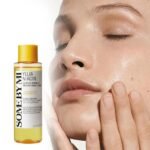
Step 2 — Repairing: For the Skin That’s Been Through a Lot
What a Damaged Skin Barrier Feels Like
You know that tight, uncomfortable feeling after washing your face? Or that dryness that no moisturizer seems to fix? That’s often your skin barrier talking — and it’s telling you it needs help.
Your skin barrier is a thin but powerful protective layer of lipids and proteins. Its job is to lock moisture in and keep irritants, pollution, and bacteria out. When it gets damaged — from harsh products, over-cleansing, stress, or environmental factors — your skin becomes reactive, dry, and dull.
Repairing skincare is about rebuilding that barrier, restoring hydration from within, and giving your skin the space to heal.
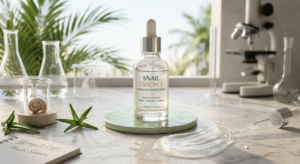
Meet Snail Mucin — The Ingredient That Sounds Weird and Works Like Magic
We know. Snail mucin. Stay with us.
Snail secretion filtrate is one of the most well-researched repair ingredients in modern skincare — and once you understand what’s inside it, the “weird” fades completely.
Here’s what makes it extraordinary:
- Glycoproteins — support skin cell regeneration and repair
- Hyaluronic acid — draws moisture deep into the skin and holds it there
- Glycolic acid — gently resurfaces, improving texture and boosting absorption
- Allantoin — calms redness, soothes irritation, and accelerates healing
- Zinc — helps blemishes fade and supports barrier recovery
Together, these components address dryness, rough texture, redness, fine lines, and acne marks — all at once. Snail Extract for Skin: A Review of Uses and Limitations — Journal of Cosmetic Dermatology It’s gentle enough for daily use, morning and evening, and it suits almost every skin type, including oily and acne-prone skin.
For a complete, portable repair routine built around this ingredient, the Snail Set Mucin Mucus Repair Hydrating Moisturizing Soothes Skin Fine Lines Cream Travel Set gives you everything you need in one beautifully simple kit — perfect for anyone whose skin is asking for a second chance.
Step 3 — Tightening: Because Firm Skin Is Not Just for “Later”
Why Skin Loses Its Bounce
Starting in our mid-to-late twenties — earlier than most of us expect — collagen production begins to slow. Collagen is the protein that keeps skin firm, plump, and elastic. And as it decreases, fine lines appear, skin starts to sag, and that “bouncy” feeling fades.
This isn’t something to fear. It’s something to address — gently, consistently, and starting now.
Retinol: The Ingredient Dermatologists Have Trusted for Decades
 When it comes to firmness and anti-aging, retinol is the ingredient with the most clinical evidence behind it. It’s a vitamin A derivative that works at a cellular level: “Human Skin Aging and the Anti-Aging Properties of Retinol — PMC –“
It accelerates cell turnover — encouraging your skin to shed old, dull cells and reveal fresher ones underneath. Fine lines soften. Uneven texture smooths out.
It boosts collagen synthesis — by activating specific receptors in the skin, retinol signals your body to produce more of the collagen it’s been losing. Over weeks, skin becomes noticeably firmer.
It refines pores and surface texture — with consistent use, pores appear smaller and skin feels more even to the touch.
How to Start With Retinol Without Scaring Your Skin
Retinol is powerful, and the most common beginner mistake is starting too fast. Here’s how to do it right:
- Start with a low concentration (0.025%–0.05%) and increase gradually
- Use it only at night — it increases UV sensitivity
- Begin with 2–3 nights per week, then build toward nightly use over a few months
- Always follow with SPF in the morning — this is non-negotiable
- Expect a short adjustment period — mild flaking or dryness in weeks 1–3 is normal and temporary
A well-formulated retinol serum will often pair the active with soothing ingredients like niacinamide or hyaluronic acid to ease that transition.
How to Build Your First Skincare Routine for Beginners
Here’s the honest advice: don’t try to do everything at once.
Choose one goal. Build around it. Give your skin 6–8 weeks to respond. Then — and only then — layer in something new.
Morning Routine — Protect & Nourish
- Cleanser — gentle, non-stripping
- Serum — brightening (rice extract or glutathione) or repairing (snail mucin)
- Moisturizer
- SPF 50+ PA++++ — always last, always non-negotiable
Evening Routine — Treat & Restore
- Cleanser
- Treatment Serum — retinol (for tightening) or snail mucin (for repair)
- Moisturizer
Beginner tip: Don’t layer retinol and vitamin C on the same night when you’re just starting out. Alternate them to let your skin adjust without overwhelm.
5 Honest Tips Every Beginner Needs to Hear
1. Your skin won’t change overnight — and that’s okay. Most ingredients need 6–12 weeks of consistent use to show real results. If you quit at week two, you’ll never know what week eight had waiting for you.
2. One new product at a time. If you introduce three new products in one week and your skin reacts, you won’t know which one caused it. Slow down. Your skin will thank you.
3. Simple wins. A 3-step routine used every single day will always outperform a 10-step routine used inconsistently. Simplicity is a strategy.
4. Your skin has its own language. Redness, breakouts, or tightness after a new product are signals — not failures. Not every ingredient suits every skin. Listen, adjust, and keep going.
5. Skincare is a form of self-love. Those few minutes you spend cleansing, moisturizing, and protecting your skin? They’re not vanity. They’re a daily act of showing up for yourself.
 Your skin has been with you through everything. It deserves consistency, patience, and a little grace.
Start with one step. Stay with it. And let the transformation begin — not overnight, but over time, which is the only way anything real ever happens.