
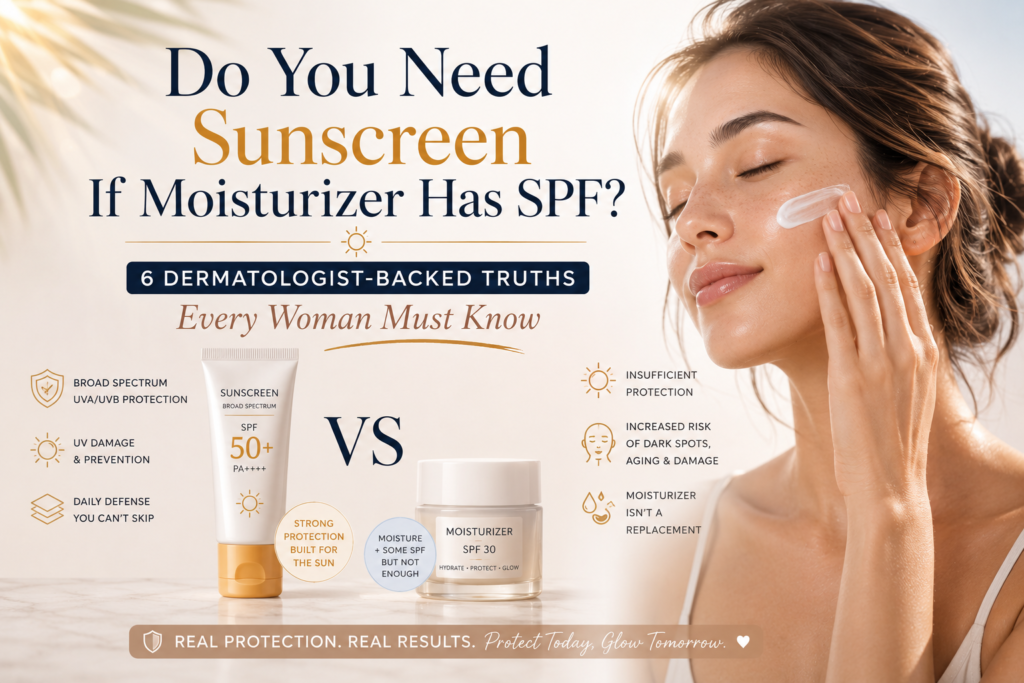
The honest, dermatologist-backed answer might surprise you — and protect your skin in ways your current routine simply isn’t.
You found a moisturizer that checks every box.
 It hydrates. It brightens. It has SPF 30 right there on the label in confident, reassuring font. You press it into your skin every morning and think: I’ve got this. I’m protected.
And then you step outside — into a full day of sunlight, into a life that keeps moving — and somewhere in that gap between what the label promises and what your skin actually needs, something gets lost.
The question do you need sunscreen if your moisturizer has SPF is one of the most Googled skincare questions in the world. Not because women are careless, but because the beauty industry has done a genuinely confusing job of answering it.
So here’s the clear, honest answer — backed by dermatological research, free of marketing language, and delivered by someone who’s spent enough time reading ingredient labels to know the difference between what sounds good and what actually works.
The Short Answer (For the Skimmers Among Us)
Yes. In almost every real-world scenario, you do need a separate sunscreen — even if your moisturizer has SPF.
Not because your moisturizer is bad. But because the way SPF works, the way moisturizers are applied, and the way the sun actually behaves on your skin are three things that were never quite designed to overlap the way the label implies.
Keep reading, because the why matters enormously here.
How SPF Actually Works — And Why Application Amount Is Everything
 Here’s something that dermatologists have known for decades but the beauty industry rarely shouts from the rooftops:
The SPF number on any product is only valid if you apply the right amount.
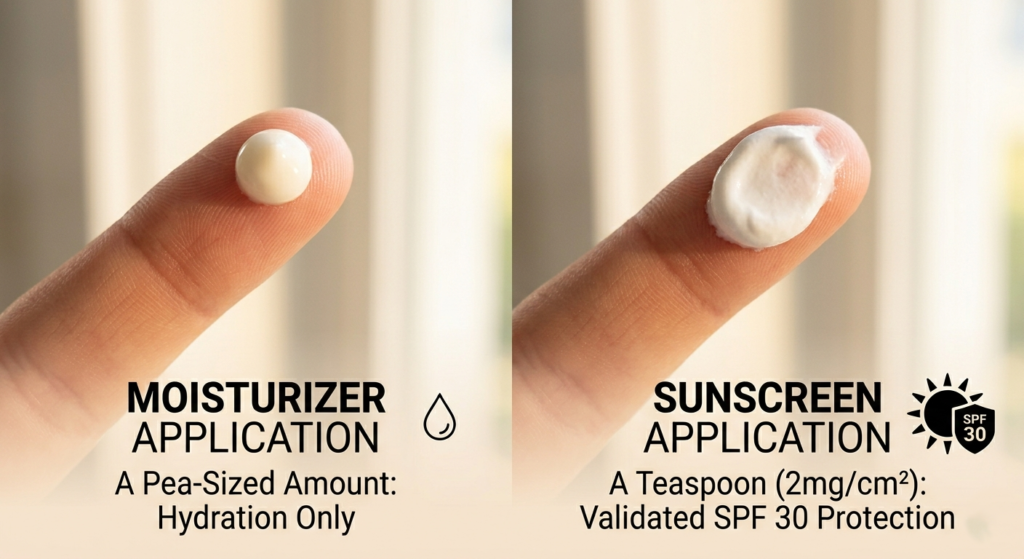
In clinical SPF testing, products are applied at 2 milligrams per square centimeter of skin. For your face alone, that translates to about a teaspoon — or, more helpfully, a nickel-sized amount of pure sunscreen.
Now think about how you apply your moisturizer.
You probably use a pea-sized amount, maybe two. You smooth it across your face with light, even strokes. You pat the excess into your neck. It feels like enough — and for hydration, it absolutely is.
But for SPF? You’re getting a fraction of the protection the label promises.
Studies have consistently shown that people apply sunscreen at 20–50% of the amount needed to achieve the labeled SPF.
[ Link to a clinical study on sunscreen application rates and SPF efficacy — e.g., pubmed.ncbi.nlm.nih.gov — search “sunscreen application amount SPF efficacy”]
When that SPF is diluted into a moisturizer you’re already applying too lightly? The protection compounds downward. You might think you’re wearing SPF 30. You’re functionally closer to SPF 8.
That’s not a minor gap. That’s the difference between protected skin and skin that’s aging — quietly, consistently — every single morning.
Why Moisturizer SPF and Dedicated Sunscreen Are Not the Same Product
There’s a formulation reality that most SPF moisturizer labels conveniently skip over.
Sunscreen is a drug product in the United States (regulated by the FDA) and a cosmetic product in Europe and many other regions — but in both cases, its formula is specifically engineered to deliver UV filters in a stable, effective way.
Moisturizers with SPF are primarily cosmetic products that have been formulated to hydrate, and then had UV filters added. The goals of these two formulations are fundamentally different:
- A moisturizer wants to absorb into skin and stay there.
- A sunscreen wants to sit on or just below the surface of skin to intercept UV rays.
When these two intentions are combined into one product, compromises happen. [Link to the AAD’s resource on sunscreen science — e.g., aad.org/public/everyday-care/sun-protection/sunscreen-patients] The UV filters may be less concentrated. The emollients that make the moisturizer feel beautiful may interfere with the way UV filters distribute across skin. The product may break down faster when it meets the natural oils on your face.
None of this means SPF moisturizers are useless. They offer something. But something and sufficient are not the same thing — especially when it comes to UV exposure.
Do You Need Sunscreen If Moisturizer Has SPF? What Dermatologists Actually Recommend
The consensus among board-certified dermatologists is consistent:
Use a dedicated sunscreen as the final step of your morning routine, applied over your moisturizer.
Dr. Henry W. Lim, a leading photobiologist and dermatologist, has noted in multiple publications that the physical act of applying moisturizer before sun protection is often additive — each layer adds a marginal amount of UV filtering — but a moisturizer with SPF should never be positioned as a replacement for standalone sunscreen.
The American Academy of Dermatology recommends:
- SPF 30 or higher, broad-spectrum
- Applied as the last skincare step, before makeup
- Reapplied every 2 hours during direct sun exposure
- 1/4 teaspoon for the face and neck as the correct application amount
[Link to AAD official sun protection guidelines — aad.org]
That reapplication point is worth pausing on. You can’t reapply a moisturizer every two hours. Your skin — and your morning routine — simply weren’t built for that. But a dedicated sunscreen, especially a lightweight fluid or setting spray sunscreen? That’s designed to be reapplied. That’s the whole point.
The UV Coverage Gap: UVA vs UVB and What “Broad-Spectrum” Really Means
 Most people know that sunscreen protects against sunburn. Fewer know the difference between the two types of UV radiation — and why both matter differently for your skin.
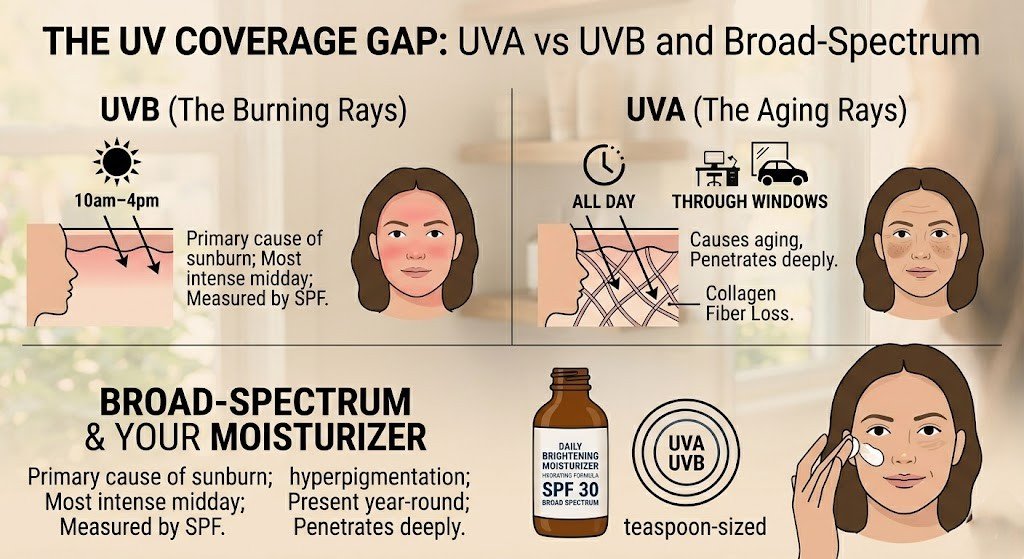
UVB rays are the burning rays. They’re most intense between 10am and 4pm. They’re what the SPF number primarily measures protection against.
UVA rays are the aging rays. They penetrate more deeply into skin, break down collagen, and contribute to hyperpigmentation, fine lines, and an uneven skin tone. Crucially — they’re present all day, even on cloudy days, and they pass through glass windows.
Yes. The UVA rays coming through your car windshield or office window right now.
The SPF number on your moisturizer only tells you about UVB protection. A product must be labeled “broad-spectrum” to address both — and even then, the level of UVA protection in many SPF moisturizers is significantly lower than what a dedicated broad-spectrum sunscreen provides.
For women dealing with:
- Melasma or dark spots
- Post-acne hyperpigmentation
- Uneven skin tone or dullness
- Premature fine lines
…the UVA gap in SPF moisturizers is not a technicality. It’s the direct reason those concerns keep resurfacing despite a consistent skincare routine.
When SPF Moisturizer Is Genuinely Enough (Rare, But Real)
There are a handful of scenarios where a well-formulated SPF moisturizer might provide adequate coverage:
- You’re spending the day almost entirely indoors, away from windows
- It’s a deeply overcast winter day with minimal UV index
- You’re using the moisturizer on top of a dedicated sunscreen (which makes it additive, not substitutive)
Even in these cases, a separate sunscreen is still the safer choice. But this isn’t about fear — it’s about giving your skin the tools it actually needs rather than the ones that are most convenient to apply.
The Routine That Actually Protects You
Getting sun protection right doesn’t require adding complexity to your morning. It requires one intentional shift:
Layer your products in the right order, with the right amounts.
The morning routine that works:
- Cleanser — gentle, appropriate for your skin type
- Toner or essence — optional, hydration-first
- Serum — vitamin C in the morning is a particularly synergistic pairing with sunscreen [Link to a peer-reviewed article on antioxidant + sunscreen synergy on PubMed — search “vitamin C sunscreen photoprotection”]
- Moisturizer — including any SPF moisturizer if you love yours
- Dedicated sunscreen — SPF 30 minimum, broad-spectrum, applied generously
- Makeup — foundation, tinted moisturizer, or SPF powder as an additional layer, never the only layer
This sequence takes roughly 90 extra seconds compared to skipping the sunscreen step.
Ninety seconds every morning, for the skin you’ll live in for the rest of your life.
Choosing a Dedicated Sunscreen That You’ll Actually Want to Wear
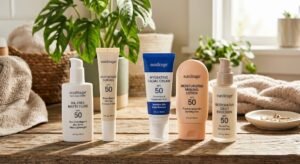 The most effective sunscreen is the one you use consistently. That sounds obvious, but it’s the single most important factor in sun protection — not the SPF number, not the brand.
For oily or acne-prone skin:
- Look for: oil-free, non-comedogenic, lightweight fluid formulas
- Key ingredients: zinc oxide (physical), or newer chemical filters like Tinosorb S or Uvinul A Plus
For dry or sensitive skin:
- Look for: hydrating base, fragrance-free, mineral-first formulas
- Key ingredients: zinc oxide, titanium dioxide, ceramides, niacinamide
For deeper skin tones concerned about white cast:
- Look for: tinted mineral sunscreens, or hybrid chemical-mineral formulas
- Newer options with iron oxides also help protect against visible light (relevant for melasma)
For the “I hate the feel of sunscreen” crowd:
- Try a sunscreen serum or essence (popular in Korean skincare)
- Or a setting spray with SPF for midday reapplication
The Honest Truth About Sun Protection and Aging
Here’s something worth sitting with:
Up to 80% of visible skin aging is attributed to UV exposure — not time, not genetics, not stress. UV.
That statistic comes from the same body of photobiology research that gives us SPF guidelines. And it means that the single most powerful anti-aging step in any skincare routine isn’t a retinol, a peptide serum, or a luxury night cream.
It’s the dedicated sunscreen you apply every single morning.
Your moisturizer with SPF is a lovely product. Keep using it if it serves your skin. But let it do what it does best — hydrate, brighten, nurture — and let a dedicated sunscreen do what it does best.
Your skin in ten years will feel the difference, even on the days you don’t.
Patch-test new sunscreen formulas before full facial use. For concerns about sun damage, hyperpigmentation, or melasma, a board-certified dermatologist can offer personalized guidance tailored to your skin’s specific needs.
♥ Continue Your Journey to Radiant Skin
If you enjoyed learning about this, you’ll find these curated guides essential for your 2026 beauty ritual:
| Article Title | Category | Quick Preview |
| Best Travel Skincare Sets: 5 Radiant Modular Swaps That Finally Work For Your Skin | Travel Skincare | Say goodbye to post-flight breakouts with these modular essentials. |
| 5 Best Ways to Remove Waterproof Makeup Without Dryness or Irritation — Your Ultimate 2026 Skin-First Guide | Sensitive Skin | Deep cleansing that respects your skin’s natural barrier. |
| 5 Radiant Reasons the Ultimate Rice Puree Travel Kit Is Your Carry-On Skincare Hero | Dry Skin | The secret to maintaining a glowing complexion at 30,000 feet. |
| Best Travel Skincare Sets: 5 Radiant Modular Swaps That Finally Work For Your Skin | Anti-Aging | Are your habits sabotaging your cells? Learn how to fix it today. |
| Dark Circles: 5 Shocking Night Habits Sabotaging Your Brightest Eyes (Fix Them in 7 Days) | Eye Care | A proven 7-day plan to restore brightness and banish fatigue. |
| Sakura Skin Care Set: 7 Powerful Secrets for Glowing, Confident Skin in Just Days | Skincare | Unlock the ancient power of Cherry Blossoms for a modern glow. |