
There’s something quietly emotional about washing your face.
 It’s the first thing you do in the morning — before the emails, before the noise, before the world asks anything of you. And it’s the last thing at night, a small ritual of letting the day go.
So when your cleanser leaves your skin feeling tight, stripped, or just off — that’s not a minor inconvenience. That’s the foundation of your whole routine quietly failing you.
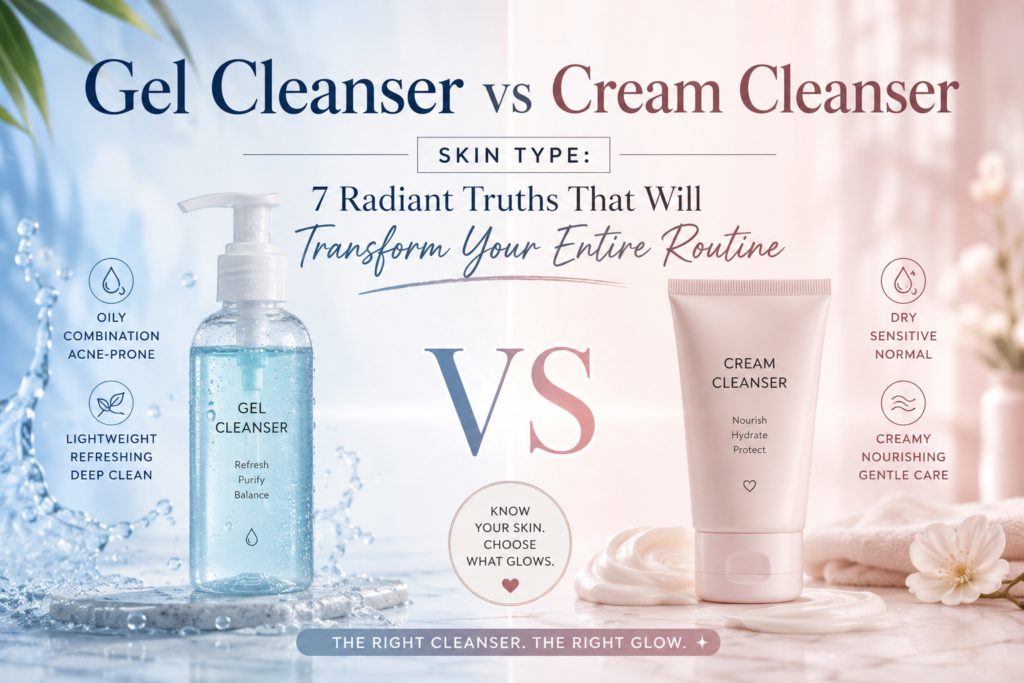
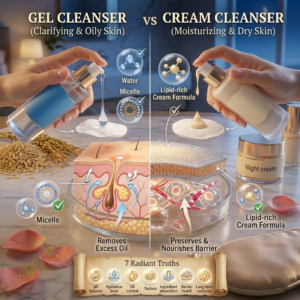
The debate between gel cleanser vs cream cleanser for your skin type is one of the most searched, most misunderstood topics in skincare. And honestly? Most of the advice out there oversimplifies it.
So let’s actually talk about it. Like two friends who’ve both had their share of bad skin days.
What Even Is the Difference? (No Jargon, Promise)
Before anything else, let’s just get clear on what these two formulas actually are — because the difference is more than texture.
Gel Cleansers: The Fresh-Start Formula
Gel cleansers are water-based, lightweight, and typically clear or translucent. They lather more readily and are formulated to cut through oil, sweat, sunscreen, and buildup without leaving a residue.
Most gel cleansers have a slightly lower pH and include ingredients like salicylic acid, niacinamide, tea tree, or glycerin — each targeting different skin concerns.
They rinse clean. They feel refreshing. And for a lot of skin types, that squeaky sensation feels like working.
But here’s the thing — that tight, squeaky feeling? It’s not always a good sign.
Cream Cleansers: The Comfort-First Formula
Cream cleansers are richer, milkier, and often opaque. They cleanse without stripping, leaning on emollients and fatty acids to dissolve impurities while maintaining your skin’s natural moisture barrier. [Link to the National Eczema Association or AAD’s skin barrier guide for context on moisture barrier science — e.g., aad.org]
Think of ingredients like ceramides, shea butter, squalane, oat extract, or hyaluronic acid. They’re not just cleaning — they’re actively caring while they clean.
They often don’t lather much. Some barely foam at all. And if you grew up thinking no lather means no clean, cream cleansers will ask you to unlearn that belief — and your skin will thank you for it.
The Gel Cleanser vs Cream Cleanser Skin Type Breakdown
This is the part that actually matters. Because “choose based on your skin type” sounds simple — until you realize most of us have complicated skin that doesn’t read the rulebook.
Oily Skin: Gel Is Usually Your Best Friend
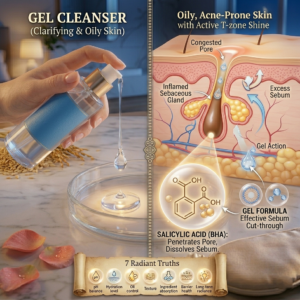 If your T-zone is consistently shiny by midday, your pores feel congested, and you break out in predictable patterns? A gel cleanser was practically designed for you.
The lightweight formula cuts through sebum effectively, and actives like salicylic acid help keep pores clear without requiring a separate step.
What to look for:
- Salicylic acid (BHA) for pore-clearing
- Niacinamide for sebum regulation
- Fragrance-free formulas (fragrance can trigger more oil production)
- pH between 4.5–5.5 (closer to skin’s natural pH)
One caveat: Over-cleansing with a gel — especially twice daily with a foaming formula — can backfire. Stripped skin overproduces oil to compensate. If your skin feels tight after cleansing, your cleanser might be too harsh, even if it’s marketed for oily skin.
Dry Skin: Cream Cleanser, No Debate
If your skin feels like it’s “pulling” an hour after moisturizing, if flakiness is a regular companion, if your complexion looks dull no matter how much water you drink — your skin barrier is begging for a gentler touch.
A cream cleanser respects that. It removes what needs to go without dismantling what needs to stay. [Link to a peer-reviewed study on ceramide-based cleansers for dry skin on PubMed or NCBI — e.g., ncbi.nlm.nih.gov]
What to look for:
- Ceramides (especially ceramide NP and AP) for barrier repair
- Squalane or jojoba oil for skin-identical hydration
- No sulfates (SLS/SLES)
- Hyaluronic acid for moisture retention
Cream cleansers also work beautifully as an evening cleanser even for non-dry types — it’s a gentle way to signal to your nervous system that the day is over.
Combination Skin: The Most Misunderstood Skin Type
Here’s what nobody tells you about combination skin: you don’t have to pick just one cleanser.
You can use a mild gel cleanser in the morning (for the oily zones that feel congested overnight) and a cream cleanser in the evening (to restore what the day took from your drier areas).
Or — and this is underrated — you can choose a gel-cream hybrid, which occupies a beautiful middle ground between both formulas.
Signs a gel-cream hybrid might be right for you:
- Your T-zone is oily but your cheeks feel tight
- You break out in the forehead and nose area but flake near your jaw
- Traditional gel cleansers leave you feeling stripped
- Cream cleansers leave a residue on your nose
Your skin’s complexity deserves a complex answer.
Sensitive Skin: It’s Not About the Category — It’s About the Ingredients
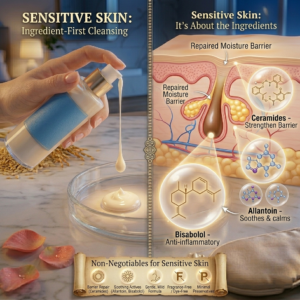 Sensitive skin is less about gel vs cream and more about what’s inside the formula.
That said — cream cleansers tend to win here, simply because they’re formulated to soothe and protect rather than clarify and purify.
Non-negotiables for sensitive skin:
- Fragrance-free (including “natural” fragrance)
- No alcohol denat (drying and irritating)
- No essential oils (lavender, citrus, eucalyptus can all trigger reactions)
- Colloidal oatmeal, centella asiatica, or allantoin for calming
A gel cleanser can work for sensitive skin — but it needs to be an exceptionally gentle, low-lather, fragrance-free formula. When in doubt, cream wins.
Acne-Prone Skin: More Nuanced Than You Think
Let’s be honest — if you have acne, you’ve probably been told “use a gel cleanser with salicylic acid” so many times it feels like the only answer.
And sometimes it is! But sometimes it isn’t.
If your acne is accompanied by dryness, flakiness, or irritation, a stripping gel cleanser can actually worsen breakouts by compromising your skin barrier. A damaged barrier is an inflamed barrier — and inflammation is acne’s best friend.
The smarter approach:
- Mild acne: A gentle gel cleanser with low-percentage BHA (0.5–1%)
- Irritated or barrier-compromised acne: A creamy, non-comedogenic formula while the barrier heals
- Hormonal acne: Cleansing formula matters less than the rest of your routine
Acne-prone doesn’t mean your skin needs to be punished. It needs to be supported.
Morning vs Evening: The Cleanser Rotation Most People Skip
One of the most transformative shifts in a skincare routine isn’t a new serum — it’s understanding that your AM and PM cleansers don’t have to be the same.
In the morning: Your skin hasn’t accumulated much. A gentle gel cleanser or even just water (for very dry skin) is often enough.
In the evening: Your skin has faced the world. Pollution, SPF, makeup, stress — a cream cleanser or a two-step oil-then-cream cleanse does a more respectful job of removing all of that without stripping your barrier before you sleep.
Think of your evening cleanse as the exhale at the end of a long day. It should feel that way.
The Signs Your Cleanser Is Wrong for Your Skin Type
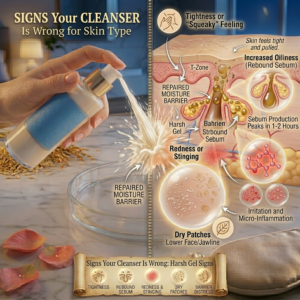 Your skin communicates constantly. Here’s what it might be trying to tell you:
Signs your cleanser is too harsh (likely a gel):
- Tightness or “squeaky” feeling post-wash
- Increased oiliness within 1–2 hours (rebound sebum)
- Redness or stinging during or after cleansing
- Dry patches appearing in previously normal zones
Signs your cleanser is too rich (possibly a cream):
- Feeling of a residue or film that doesn’t rinse off
- More congestion or clogged pores since switching
- Breakouts in areas that were previously clear
- Skin looks “heavy” or dull in the morning
Neither feeling is you — it’s just feedback. Adjust accordingly.
A Quick Reference: Gel vs Cream by Skin Concern
| Skin Type / Concern | Best Choice | Why |
|---|---|---|
| Oily / Acne-prone | Gel cleanser | Cuts through sebum, includes BHAs |
| Dry / Dehydrated | Cream cleanser | Maintains moisture barrier |
| Sensitive / Reactive | Cream (gentle) | Soothes and protects |
| Combination | Gel-cream hybrid or both | Addresses multiple zones |
| Normal | Either — personal preference | Focus on ingredient quality |
| Mature skin | Cream cleanser | Supports barrier and suppleness |
What the Dermatological Community Says
Dermatologists consistently point to pH balance and surfactant type as the two biggest factors in cleanser irritation — not gel vs cream as a category.
Harsh sulfates (SLS, SLES) in gel cleansers are among the most common causes of barrier disruption. Meanwhile, a well-formulated cream cleanser with gentle surfactants like cocamidopropyl betaine or decyl glucoside can cleanse even oily skin without causing sensitivity.
The texture matters. The formula matters more.
The Real Answer Nobody Talks About
The gel cleanser vs cream cleanser skin type debate has a quieter truth hiding underneath it:
Your skin changes.
It changes with the seasons. It changes with your hormones. It changes with stress, with sleep, with the city you live in.
The cleanser that worked beautifully in summer might be too stripping in winter. The cream you loved in your twenties might feel too heavy in your forties. The gel that cleared your skin last year might not serve you through a stressful season now.
Choosing a cleanser isn’t a one-time decision. It’s an ongoing conversation with your skin — one that asks you to stay curious, stay gentle, and stay willing to listen.
Your skin isn’t difficult. It’s just asking to be understood.
And now, you’re a little better equipped to do exactly that.
Always patch-test new cleansers before incorporating them fully into your routine. For persistent skin concerns, a consultation with a board-certified dermatologist is the most personalized path forward.
♥ Continue Your Journey to Radiant Skin
If you enjoyed learning about this, you’ll find these curated guides essential for your 2026 beauty ritual:
| Article Title | Category | Quick Preview |
| Best Travel Skincare Sets: 5 Radiant Modular Swaps That Finally Work For Your Skin | Travel Skincare | Say goodbye to post-flight breakouts with these modular essentials. |
| 5 Best Ways to Remove Waterproof Makeup Without Dryness or Irritation — Your Ultimate 2026 Skin-First Guide | Sensitive Skin | Deep cleansing that respects your skin’s natural barrier. |
| 5 Radiant Reasons the Ultimate Rice Puree Travel Kit Is Your Carry-On Skincare Hero | Dry Skin | The secret to maintaining a glowing complexion at 30,000 feet. |
| Best Travel Skincare Sets: 5 Radiant Modular Swaps That Finally Work For Your Skin | Anti-Aging | Are your habits sabotaging your cells? Learn how to fix it today. |
| Dark Circles: 5 Shocking Night Habits Sabotaging Your Brightest Eyes (Fix Them in 7 Days) | Eye Care | A proven 7-day plan to restore brightness and banish fatigue. |
| Sakura Skin Care Set: 7 Powerful Secrets for Glowing, Confident Skin in Just Days | Skincare | Unlock the ancient power of Cherry Blossoms for a modern glow. |