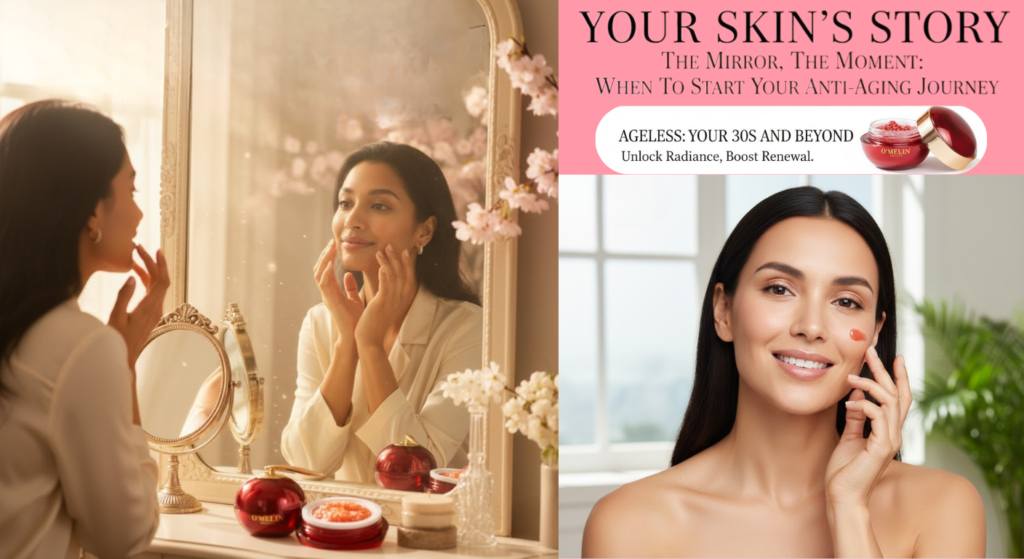

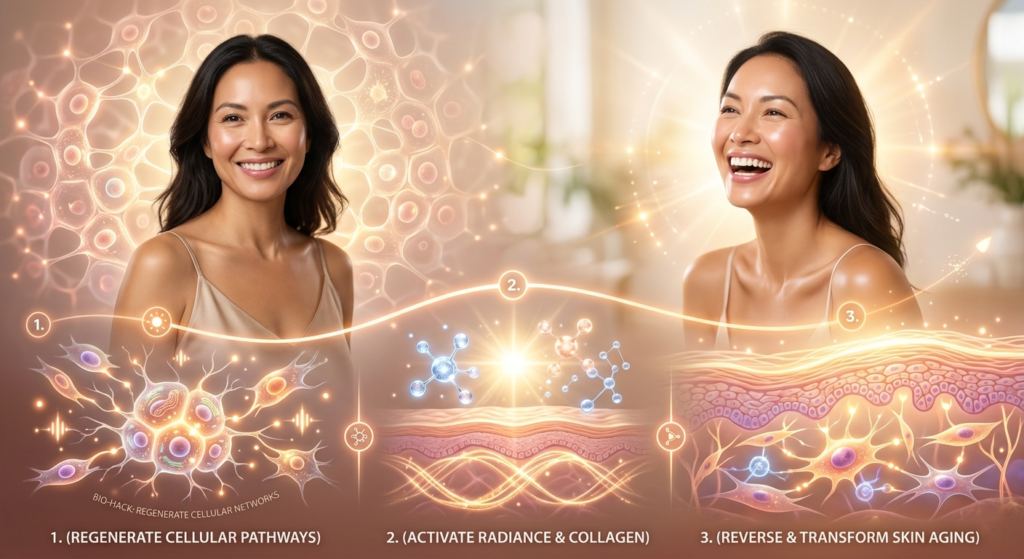
Have you ever looked in the mirror on a random Tuesday and thought — when did this happen?
Not a dramatic overnight change. Just a slow, quiet shift. A little less bounce. A little more dullness. Lines that weren’t there last summer, now staying even after a full night’s sleep.
You’re not imagining it. And no, it’s not just “getting older.”
Your skin has actually stopped talking to itself — and once you understand why, everything about your routine changes.
What Is the ‘Cell Phone Theory’ of Skin Aging?
Here’s a metaphor that will genuinely change how you think about your skin.
Imagine your skin cells are like phones. When you’re in your teens and twenties, those phones have full signal. Every cell is sending and receiving messages constantly — “make more collagen,” “repair this damage,” “renew this layer.” Communication is fast, clear, and efficient.
After 30? The signal starts dropping.
Skin cell communication after 30 slows dramatically because of a biological process called cellular senescence — when aging cells stop dividing and start sending out chaotic, inflammatory signals instead of healthy ones. The Role of Cellular Senescence in Skin Aging – National Institutes of Health (PubMed)
Think of it like those dropped calls that leave you with half a conversation. Your skin is hearing every other word. The result?
- Collagen production slows (hello, loss of firmness)
- Cell turnover takes longer (hello, dullness and uneven texture)
- Barrier repair becomes sluggish (hello, dryness and sensitivity)
This isn’t a flaw. It’s biology. But here’s the beautiful part — biology can be supported.
Why Your Skin “Goes Quiet” After 30
The Science Behind Slowing Cell Signals
Two key messengers drive youthful skin communication: growth factors and cytokines. When you’re young, these proteins act like a perfectly coordinated group chat — everyone gets the message, everyone responds.
As we age, the production of beneficial growth factors drops while inflammatory signals increase. Dermatologists sometimes call this “inflammaging” — a low-grade, chronic inflammation that accelerates how our skin visibly ages. Understanding the Role of Inflammaging in Skin Aging – National Institutes of Health (PMC)]
The Collagen Clock
After 25, we lose roughly 1% of our collagen per year. By 30, that starts becoming visible. By 40, cumulative loss changes the architecture of skin entirely — less structural support, less elasticity, less of that natural “snap back” quality we took for granted.
What makes this worse? Sun exposure, chronic stress, poor sleep, and a high-sugar diet all accelerate that cellular static. Your skin’s signal gets noisier and weaker at the same time.
The Turnover Slowdown No One Warned You About
In your teens, skin cells renewed themselves every 2–3 weeks. By your 30s? That cycle stretches to 4–6 weeks. By your 50s, it can take up to 8 weeks.
This is why your skin looks dull even when you’re hydrating and sleeping well. Fresh, luminous cells are forming — they’re just taking forever to reach the surface.
The 3-Step Bio-Hack to Restore Skin Cell Communication After 30
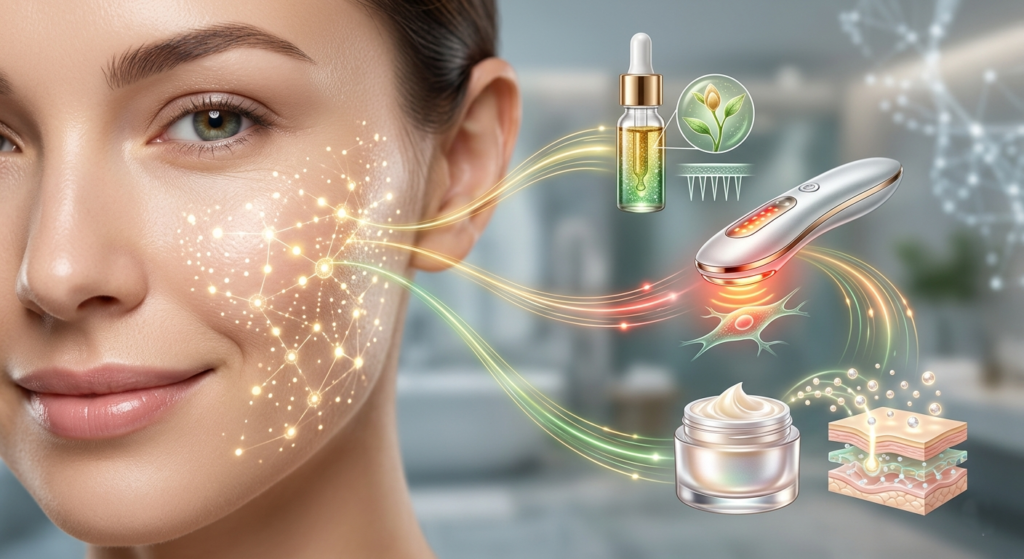
These aren’t trendy gimmicks. Each step targets a specific breakdown in your skin’s communication system — and together, they work synergistically.
Step 1: Re-Open the Lines with Exfoliation (But Not the Way You Think)
Most women over-exfoliate. Or worse, they use harsh physical scrubs that create micro-tears and accelerate inflammation.
The smarter approach? Chemical exfoliation using AHAs (alpha-hydroxy acids) like glycolic or lactic acid.
These work by dissolving the “glue” holding dead cells onto the surface — clearing the channel so your skin’s messages can actually get through. When fresh cells reach the surface faster, your skin receives its own renewal signals more clearly. Mechanism of Action and Efficacy of Alpha-Hydroxy Acids – Clinical, Cosmetic and Investigational Dermatology
How to use it:
- Start with a low-concentration lactic acid toner (5–8%) two to three times per week
- Always apply SPF the next morning — exfoliated skin is more photosensitive
- Gradually work up as your skin adjusts; consistency matters more than intensity
Step 2: Amplify the Signal with Targeted Actives
Once the channel is clear, you need to send the right messages. Two ingredients stand above the rest here:
Niacinamide (Vitamin B3)
Niacinamide is essentially a translator for your skin. It supports the repair of the skin barrier, regulates sebum, calms inflammation, and has been shown to visibly reduce hyperpigmentation and fine lines with consistent use.
More importantly — it enhances how skin cells respond to each other’s signals. It’s the ultimate communication booster.
Retinoids (Vitamin A derivatives)
If niacinamide is the translator, retinoids are the software update.
Retinoids — whether prescription tretinoin or over-the-counter retinol — work by binding to retinoid receptors in skin cells and essentially rebooting cellular behavior. They increase cell turnover, stimulate collagen synthesis, and reduce the appearance of fine lines over time.
They’re also the most studied, evidence-backed ingredient in all of skincare. Retinoids in the Treatment of Skin Aging – American Academy of Dermatology
A gentle heads-up: Retinoids require a slow introduction. Start once a week, on clean, dry skin. Let your skin adapt before increasing frequency. The “retinol purge” is real but temporary — think of it as your skin updating its operating system.
Step 3: Protect the Network with Barrier Support
Here’s the step most people skip — and it might be the most important one.
Even if you’re doing steps one and two beautifully, it means nothing if your skin barrier is compromised. A damaged barrier creates constant background noise in your skin’s communication system — making it harder for any active ingredients to do their job and leaving skin reactive, dry, and inflamed.
Barrier support comes down to three things:
Ceramides — lipid molecules that form the “mortar” between skin cells. They literally seal the gaps in the barrier and prevent water loss. The Importance of Ceramides in Skin Barrier Function – Healthline Medical Review Look for them in moisturizers and barrier creams.
Peptides — short chains of amino acids that act as direct messengers to your skin, signaling it to produce more collagen and elastin. They work in harmony with retinoids and niacinamide without irritation, making them perfect for sensitive skin.
Occlusives and humectants together — hyaluronic acid pulls water into the skin; squalane or shea butter locks it in. Using both in your evening routine is like handing your skin a full glass of water rather than letting it evaporate.
The Routine in Real Life
You don’t need a 12-step regimen. Here’s what skin cell communication support looks like on a real Tuesday morning when you’re already running late:
Morning: Gentle cleanser → Niacinamide serum → Moisturizer with ceramides → SPF (non-negotiable)
Evening (2–3x per week): Gentle cleanser → Lactic acid toner → Wait 20 minutes → Retinol (low strength to start) → Barrier moisturizer with peptides
Evening (other nights): Gentle cleanser → Hydrating serum → Rich ceramide moisturizer → Rest
Simple. Intentional. And kind to your skin at every stage.
A Note on What This Isn’t
 This isn’t about chasing youth. This isn’t about looking 22 again.
Restoring skin cell communication after 30 is about helping your skin do what it was always designed to do — just with a little more support as the environment changes. It’s the difference between your skin surviving and your skin thriving.
There will still be tired mornings and stress breakouts and days when the glow just isn’t there.
But there will also be those moments — standing in good light, maybe not wearing much makeup — when you catch your reflection and think: oh, there she is.
That’s the goal. That quiet, confident recognition.
Frequently Asked Questions
⇒ At what age should I start supporting skin cell communication? You don’t need to wait for visible signs. Building a barrier-supportive, niacinamide-inclusive routine in your late 20s creates a strong foundation before the slowdown fully sets in.
⇒ Can I use AHAs and retinol in the same routine? Not on the same night, especially when starting out. Alternate them — exfoliation nights and retinol nights — to minimize irritation and respect your skin barrier.
⇒ How long before I see results from these steps? Honest answer: six to twelve weeks of consistent use is the minimum window for most people. Skin cell turnover takes time. Stay patient and take progress photos — changes are often subtle until suddenly they’re not.
⇒ Is this routine safe for sensitive skin? Yes, with adjustments. Start slower, use lower concentrations, and prioritize barrier repair first. Sensitive skin can absolutely thrive with these steps — it just needs a gentler introduction.
Always patch-test new actives. If you have a diagnosed skin condition or are pregnant, check with a board-certified dermatologist before introducing retinoids or strong exfoliants into your routine.
♥ Continue Your Journey to Radiant Skin
If you enjoyed learning about the skin microbiome, you’ll find these curated guides essential for your 2026 beauty ritual:
| Article Title | Category | Quick Preview |
| Best Travel Skincare Sets: 5 Radiant Modular Swaps That Finally Work For Your Skin | Travel Skincare | Say goodbye to post-flight breakouts with these modular essentials. |
| 5 Best Ways to Remove Waterproof Makeup Without Dryness or Irritation — Your Ultimate 2026 Skin-First Guide | Sensitive Skin | Deep cleansing that respects your skin’s natural barrier. |
| 5 Radiant Reasons the Ultimate Rice Puree Travel Kit Is Your Carry-On Skincare Hero | Dry Skin | The secret to maintaining a glowing complexion at 30,000 feet. |
| Best Travel Skincare Sets: 5 Radiant Modular Swaps That Finally Work For Your Skin | Anti-Aging | Are your habits sabotaging your cells? Learn how to fix it today. |
| Dark Circles: 5 Shocking Night Habits Sabotaging Your Brightest Eyes (Fix Them in 7 Days) | Eye Care | A proven 7-day plan to restore brightness and banish fatigue. |
| Sakura Skin Care Set: 7 Powerful Secrets for Glowing, Confident Skin in Just Days | Skincare | Unlock the ancient power of Cherry Blossoms for a modern glow. |